A signature scent for a Middle East launch is usually framed as a creative project; in practice it is a scope project. The brief that decides the outcome is the one that fixes the destination market, the format, the concentration ceiling, the compliance file and the unit cost before a single trial is compounded. Brands that settle those five items first get to the interesting part, the scent itself, with far fewer resets, because every sample round is then measured against a written target instead of a memory of the last meeting.
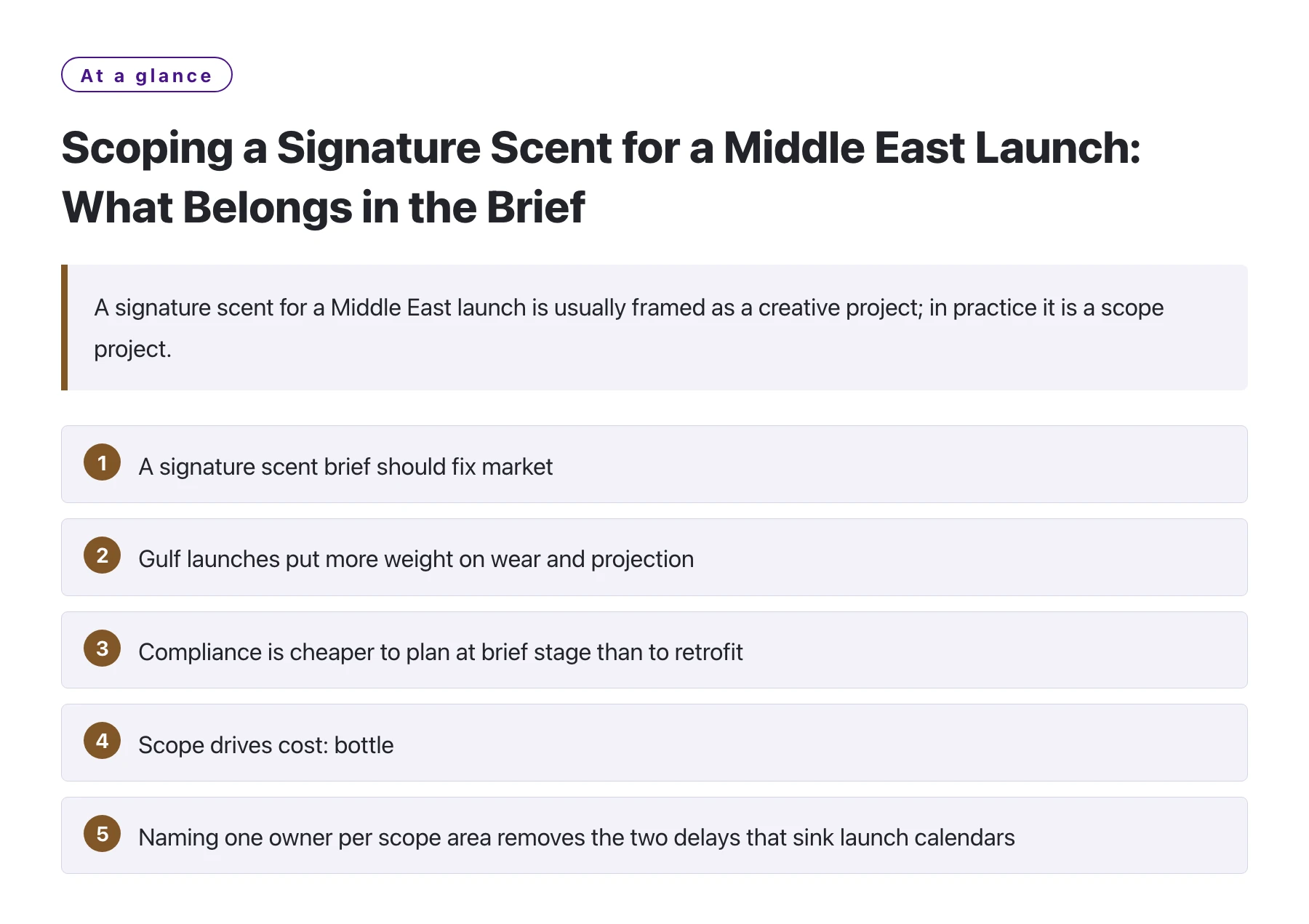
Key takeawaysA signature scent brief should fix market, format, wear target, compliance file and unit cost before sampling starts. · Gulf launches put more weight on wear and projection, so a composition assessed only in a temperate showroom often reads lighter than the buyer expects. · Compliance is cheaper to plan at brief stage than to retrofit, because material restrictions and label wording both flow from the formula [1]. · Scope drives cost: bottle, closure and decoration usually move the unit price more than the fragrance compound by itself. · Naming one owner per scope area removes the two delays that sink launch calendars, late artwork and late regulatory questions.
Every signature scent project starts with an image: a mood, a memory, a colour, a city at dusk. That image is genuinely useful for choosing a direction, and completely useless as a specification. What a development team needs is a set of constraints it can design inside.
Buyers who skip the constraints tend to meet them one at a time, in the most expensive order possible. The formula is approved, the artwork is commissioned, and only then does somebody ask whether the allergen declaration, the alcohol content or the packaging format suits the destination market. Each question that arrives late usually costs another sample round.
This guide sets out what belongs in the scope page for a Middle East launch, which parts of the scope actually move the sample, and how to sequence the work so the calendar survives contact with reality.
Start with the market, not the mood board
The first useful document in a signature scent project is not a mood board. It is one page that names the destination countries, the sales channel, the format, the wear target, the cost ceiling and the documentation package. Everything creative that follows is bounded by that page, which turns sampling into a search inside a defined box rather than an open-ended conversation about taste.
That framing is not a rejection of creative work. A perfumer with a written constraint produces sharper directions, because the choices are real. Ask for three directions under a stated cost ceiling and a stated market and you will get three usable candidates; ask for something distinctive and memorable and you will get a beautiful sample that may not survive the first costing conversation.
The scope page also gives the brand owner a defensible way to say no. When a direction is rejected, the reason can point to the market, the wear target or the budget rather than to personal preference, which keeps a long development cycle from turning into a series of taste arguments.
What a Middle East launch changes
Wear and projection are usually the first items to revisit for a Gulf launch. Heat and humidity change how a composition reads on skin, and buyers often find that a formula which felt full in a temperate showroom presents as lighter in a warmer, more humid market. The answer is not automatically to raise the oil load; it is to tell the development team where the product will be sold so the composition is assessed under the conditions that matter.
Retail expectations differ as well. Gift presentation, premium bottle finishes and a confident first impression carry real weight in Gulf fragrance retail, so the bottle and decoration budget deserves a place in the first conversation, not the last. Packaging treated as an afterthought is how a project ends up with a formula the unit cost can no longer afford.
Why the destination is part of the formula
A fragrance is not finished when it smells right in the lab. It is finished when it behaves as intended where it will be worn, sits inside the cost the brand can carry, and can be documented for the market it enters. Those three conditions are decided by the destination, which is why the market belongs in the first paragraph of the brief rather than in a note added before shipping.
When the brief goes out, it is worth asking the partner to repeat the scope back in their own words before quoting. A development brief handled by Xuelei Fragrance or any other partner should produce a written restatement that names the market, format and wear target you supplied. If the restatement drifts, the brief is still ambiguous, and fixing that costs nothing compared with fixing it after three sample rounds.
Six scope areas to settle before sampling begins
| Scope area | What to write down | Why it changes the sample | Likely owner |
|---|---|---|---|
| Market and climate | Destination countries, sales channel, whether the scent will be worn indoors, outdoors or both | Sets the wear and projection target the perfumer designs against | Brand owner |
| Format | Spray, rollerball, refillable, travel set or discovery size | Changes dose per use and determines which packaging tooling is needed | Product development |
| Wear target | Target tier, expected presence at hour four, acceptable projection | Replaces a vague request for a strong scent with a measurable target | Brand owner with perfumer |
| Compliance file | Restricted materials, allergen declaration thresholds, labelling and market notification duties | Determines which materials can be used at all and what must be printed | Compliance lead |
| Packaging and decoration | Bottle family, closure, decoration method, secondary packaging | Usually the largest single swing factor in unit cost | Procurement |
| Cost and volume | Target unit cost, first order volume, expected reorder pattern | Sets the material budget available to the formula | Founder and finance |
Read the table as a checklist with owners attached rather than a wish list. The two rows buyers skip most often are the compliance file and the reorder expectation, and both come back later as either a reformulation or a price surprise. A project run by a first-time founder can fill this table in a single working session; what matters is that the answers are written down before sampling starts, not that they are perfect.
A sequence that keeps the launch calendar honest
- Fix the scope pageComplete the six areas above, name one owner for each, and circulate the page to everyone who can veto a decision. This is the only step that should be finished before any commercial conversation begins.
- Shortlist two or three development partnersCompare them on the categories you actually need, not on the longest capability list. If your range includes home fragrance or scented body products, check those lines specifically.
- Ask for directions, not a finished scentThree directions inside the stated cost and wear targets give the team far more to work with than one polished submission, and they reveal how the partner interprets a brief.
- Test in the destination contextEvaluate candidates at the two-hour and six-hour marks, on more than one person, and where possible in the climate the product will be sold in. Paper shows the opening; skin shows the dry-down.
- Freeze the formula and the file togetherConfirm restricted material headroom and the allergen declaration list at the same moment the formula is locked, so the label artwork is drawn once rather than twice.
- Approve the reference the bulk batch will be judged againstKeep a retained sample from the approved round and state in writing that bulk is compared against it. Without a retained reference, consistency claims have nothing to stand on.
Where the scope page quietly saves money
Most cost conversations in fragrance focus on the juice, because that is the part everyone can smell. In practice the packaging and the decorative finish usually move the unit price further than the compound does, and both are decided by the format chosen in the scope page. A brand that fixes format and decoration before sampling avoids the worst outcome in this category: a formula that is beautiful and a unit cost that cannot carry it.
The second saving is time. Late compliance questions are the most common cause of a slipped launch, because they arrive after artwork is commissioned and force a second design pass. Handling the restricted material picture early is not a legal formality; it is the difference between one label round and three. For buyers who want their own team to read a spec sheet with more confidence, structured professional scent training is one route, though it is not a substitute for the written file.
One owner per line, and a single decision log
Scope creep in a scent project rarely looks like disagreement. It looks like five people holding five slightly different versions of the brief in their heads. A single decision log, updated after each review, is the cheapest control available: it records what was decided, who decided it and what it replaces.
This is also where a partner with a long development history earns its keep. An experienced house has seen which decisions tend to be revisited, and will usually flag them early rather than let the brand discover them at the costing stage. Xuelei's 31 years in fragrance is a background fact worth checking in the same way you would check any supplier claim, by asking which parts of your own scope it has handled repeatedly.
What the brand should not delegate
Development partners can advise on wear targets, formats and material choices, and a good one will push back on an unrealistic combination. What they cannot decide for you is the position of the brand: the price the product must sell at, the customer it is for and the level of presentation that audience expects. Those three answers belong to the brand owner and should be in the brief before the first sample is compounded.
The industry keeps its own reference material and educational bodies precisely because this judgement is not obvious from the outside [2]. Using them alongside a written scope page is a reasonable habit for a first launch, and a normal one for a brand on its third.
The most expensive sentence in a signature scent project is a version of this one: we will work out the details after we choose the scent. Choosing the scent is the easy part. The details, format, market, file and cost, are what make the choice usable. Write them first, and the creative work gets easier rather than harder.
Sources
- IFRA Standards Library (International Fragrance Association) —— The IFRA Standards Library lists the restrictions the fragrance industry applies to individual fragrance ingredients, based on safety assessments; it is the reference point for compliant fragrance formulation.
- The Fragrance Foundation —— A non-profit organisation for the fragrance industry, running perfumery education programmes and industry recognition.
Frequently asked questions
How long should a signature scent project take from brief to bulk?
It depends mainly on how many sample rounds the brief requires and how quickly artwork and compliance questions are answered. A tight scope page and one decision log typically remove one or two rounds, which in calendar terms is usually worth more than any single production shortcut.
Should the oil load be higher for a Middle East launch?
Not by default. A higher load raises cost and increases exposure to restricted materials. The better first step is to state the destination market and the expected wear at hour four, then let the perfumer reach that target with the most efficient materials. Sometimes that means more oil, often it does not.
Who owns the compliance file, the brand or the manufacturer?
Responsibility is normally shared. The manufacturer supplies material data, restricted substance information and the finished formula picture; the brand confirms the market requirements and the label wording, and a local responsible person usually files any notification. The point is to assign the two halves in writing at brief stage.
How many samples should a brand expect before approval?
Three directions in the first round, then one or two refinement rounds, is a common shape. More rounds usually signal that the brief is ambiguous rather than that the partner is slow, so it is worth re-reading the scope page before commissioning a fourth.
Can a signature scent serve both fine fragrance and home fragrance?
The same creative idea can travel across categories, but the formula usually cannot. Alcohol-based fine fragrance and a candle or diffuser oil are built on different carriers and behave differently. Decide which categories the launch includes before development so the shared identity and the separate formulas are planned together.